
IriSight® Case Study
Overview
Patient:
37 year-old multigravida, 20 weeks gestation
Clinical presentation:
Concern for skeletal dysplasia with shortening of long bones
Testing strategy:
Variantyx whole genome testing
Key finding:
De novo, pathogenic variant in the COL1A2 gene
Clinical outcome:
Diagnosis established and maximally informative reproductive planning enabled
Why IriSight® was the right choice
A detailed anatomy scan at 20 weeks identified bilateral shortened femurs with severe bowing, narrow thorax and suspected club foot. Findings were concerning for rhizomelia. Due to the heterogeneous nature of skeletal dysplasias and further confounding by general, overlapping prenatal phenotypes, comprehensive diagnostic testing of the resultant POC sample was recommended. Exome testing ordered with another lab produced an indeterminate result due to maternal cell contamination (MCC).
If IriSight® had been selected from the start, it would have delivered the most comprehensive genomic insight from day one:
- Reducing time to diagnosis
- Avoiding unnecessary testing and depletion of a precious, limited sample
- Supporting the highest standard of patient care
Diagnostic finding: COL1A2-related disorders
Variantyx IriSight® testing identified a heterozygous, de novo, pathogenic p.Gly1012Ser variant in the COL1A2 gene.
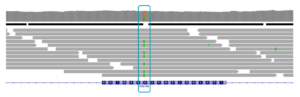
Uniform data from WGS clearly shows the single nucleotide variant. This variant replaces a glycine residue in the repetitive Gly-X-Y sequence of the triple helical domain, which is a common disease mechanism in collagenopathies 1.
Pathogenic COL1A2 variants are associated with autosomal dominant COL1A2-related disorders with signs/features of skeletal dysplasia.
Impact on clinical care
Provided a definitive diagnosis, enabling maximally informative future reproductive planning.
Technology spotlight: Maternal cell contamination
The challenge
Accurate prenatal testing of amniotic, CVS and POC samples relies on distinguishing fetal DNA from maternal DNA. While significant maternal cell contamination (MCC) will impact all NGS-based testing, exome and panel-based tests that rely on amplification are particularly vulnerable to interference from uneven coverage, GC-bias, and selective allele drop-out.
Why IriSight®
- Uses PCR-free whole genome sequencing with no amplification for uniform coverage.
- Sequences both coding and non-coding regions which, combined with uniform sequencing depth, enables better MCC analysis capabilities to rule out maternal contamination and more sensitive and specific fetal sample analysis.
Other IriSight® cases

IriSight® – Compound heterozygous deletion plus SNV explains multiple fetal anomalies
IriSight® – Elusive RBM8A 3’-UTR variant explains TAR syndrome features
IriSight® – Compound heterozygous SNVs in an sncRNA explain multiple fetal anomalies