
OncoAlly® Hereditary Cancer Case Study
Overview
Patient:
Male in his early 50’s
Clinical presentation:
Colon cancer
Testing strategy:
Variantyx whole genome testing
Key finding:
2.96 kb deletion mapped to the PMS2CL pseudogene
Clinical outcome:
Ruled out a PMS2 deletion and Lynch syndrome diagnosis
Why OncoAlly® was the right choice
Following the patient’s stage IV colon cancer diagnosis, a hereditary cancer panel was ordered to test for germline variants that may provide insight into the cancer’s origin and possible treatment options. Testing ordered with another lab produced an indeterminate result. A 2.96 kb deletion was identified, but the lab was unable to determine if it resided in the PMS2 gene associated with Lynch syndrome or its pseudogene PMS2CL.
If OncoAlly® had been selected from the start, it would have delivered the most comprehensive genomic insight from day one:
- Reducing time to diagnosis
- Avoiding unnecessary testing
- Supporting the highest standard of patient care
Diagnostic finding: Lynch syndrome ruled out
Variantyx OncoAlly® hereditary cancer testing identified the 2.96 kb deletion.
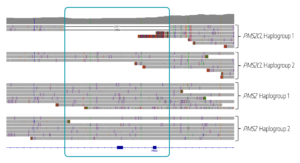
Confirmatory long-read sequencing unambiguously shows that the deletion resides in one of the haplogroups of the PMS2CL pseudogene (see PMS2CL Haplogroup 1 at the top), where it spans two exons. In contrast, the corresponding regions of both PMS2 haplogroups remain intact (see PMS2 Haplogroup 1 and PMS2 Haplogroup 2 at the bottom), ruling out Lynch syndrome.
Additionally, Variantyx OncoAlly® hereditary cancer testing identified two heterozygous variants of uncertain significance in the ATM gene (not shown) which is associated with autosomal dominant susceptibility to hematological and solid tumor malignancies.
Impact on clinical care
Ruling out Lynch syndrome has the potential to change the treatment plan if the patient’s tumor is also determined to be negative for somatic mutations and acquired gene silencing associated with deficient mismatch repair. More significantly, ruling out Lynch syndrome changes the preventative and lifetime surveillance plan for independent cancers. It also changes the risk profile for close family members, impacting the need for follow-on screening.
Technology spotlight: Pseudogene interference
The challenge
The PMS2CL pseudogene is an inverted partial duplication of the PMS2 gene, with >99% sequence identity existing across the shared coding regions. Because short-read technologies, including targeted panels, exomes and standard genomes, rely on short DNA fragments ~150-300 bp in size, bioinformatic analysis pipelines are unable to determine which gene the fragments originated from. Even when a small one or two exon deletion is detected, it can be impossible to determine whether it resides within PMS2 or PMS2CL.
Why OncoAlly®
- Has a detection range from 1 bp to whole chromosomal events, easily detecting small, one and two exon deletions of any size.
- Sequences and analyzes both coding and non-coding regions, enabling breakpoint detection regardless of location.
- Confirmatory long-read genome sequencing produces individual, continuous reads thousands of nucleotides in length that enable unambiguous mapping to either PMS2 or its pseudogene PMS2CL.
Additional similar cases

OncoAlly® Hereditary Cancer – TP53 intronic deletion explains extensive, multi-cancer family history
OncoAlly® Hereditary Cancer – SDHB single exon deletion informs paraganglioma management