
OncoAlly® Hereditary Cancer Case Study
Overview
Patient:
Male in his mid 40’s
Clinical presentation:
History of bilateral carotid paraganglioma
Testing strategy:
Variantyx whole genome testing
Key finding:
Pathogenic 15.68 kb deletion in the SDHB gene
Clinical outcome:
Diagnosis established and family testing enabled
Why OncoAlly® was the right choice
Despite prior non-diagnostic multi-gene cancer panel + RNA analysis testing, a concern for hereditary cancer susceptibility remained due to the patient’s personal history of bilateral carotid paraganglioma and family history of lung, gastric and prostate cancer.
OncoAlly® was selected because it delivers the most comprehensive genomic insight from the start while:
- Reducing time to diagnosis
- Avoiding unnecessary testing
- Supporting the highest standard of patient care
Diagnostic finding: Hereditary pheochromocytoma / paraganglioma syndrome 4
Variantyx OncoAlly® hereditary cancer testing identified a heterozygous, pathogenic 15.68 kb deletion that removes exon 1 of the SDHB gene.
The deletion is expected to result in loss of protein function.
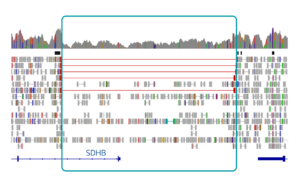
Uniform data from WGS clearly shows the 15.68 kb single exon deletion.
Impact on clinical care
Surgery is likely to be recommended over observation as paragangliomas associated with germline SDHB variants are aggressive and more prone to metastasis. In addition, targeted follow-on screening of at-risk family members was enabled.
Variant spotlight: Single exon deletions
Detection challenges
Targeted tests are typically unable to detect deletions smaller than 500 bp, a size that individual exons often fall below. Furthermore, panel tests focus on coding regions only, ignoring intergenic and intronic sequences. This leads to critical coverage gaps that make it impossible to detect deletion breakpoints within these regions.
Why OncoAlly®
- Has a detection range from 1 bp to whole chromosomal events, easily detecting single exon deletions of any size.
- Sequences and analyzes both coding and non-coding regions, enabling breakpoint detection regardless of location.
Additional similar cases

OncoAlly® Hereditary Cancer – TP53 intronic deletion explains extensive, multi-cancer family history