IriSight® Case Study
Overview
Patient:
41 year-old primagravida, 28 weeks gestation
Clinical presentation:
IUGR, left congenital diaphragmatic hernia, short long bones, bilateral pyelectasis, mild polyhydramnios
Testing strategy:
Variantyx whole genome testing
Key finding:
Pathogenic p.Glu1248Ter SNV in the MED12 gene
Clinical outcome:
Diagnosis established and birth planning plus future reproductive planning enabled
Why IriSight® was the right choice
An anatomy scan at 28 weeks identified a congenital diaphragmatic hernia (CDH) with associated bilateral pyelectasis and mild polyhydramnios. While CDHs often arise in isolation through multifactorial causes, a CDH arising from a genetic syndrome would impact prognosis and recurrence risk.
IriSight® was selected as the initial test because it delivers the most comprehensive genomic insights from the start:
- Reducing time to diagnosis
- Avoiding unnecessary testing
- Supporting the highest standard of patient care
Diagnostic finding: X-linked MED12-related disorders
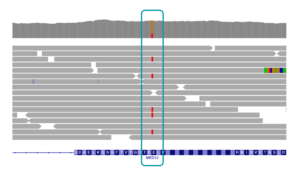
Variantyx IriSight® testing identified a heterozygous, de novo, pathogenic p.Glu1248Ter variant in the MED12 gene. The variant is expected to result in loss of protein function.
While most X-linked MED12-related disorders affect males, females with Hardikar syndrome caused by loss of function MED12 variants exhibit a range of congenital anomalies, including congenital diaphragmatic hernia.
Impact on clinical care
Enabled birth planning as well as maximally informative future reproductive planning.
Spotlight on comprehensive testing
Challenges
Most prenatal testing limits reporting to variants associated with disorders having a significant phenotypic overlap with the observed ultrasound findings. Yet fetal phenotypes are often limited by gestational age, fetal positioning and available technology, thereby leading to missed reporting of clinically relevant variants.
Why IriSight®
- Considers partially overlapping and non-specific fetal phenotypes for clinically relevant pathogenic and likely pathogenic variants
- Goes beyond the available phenotypic information to identify pathogenic and likely pathogenic variants associated with early-onset genetic disorders, overcoming the limitations imposed by prenatal clinical presentation and phenotypic heterogeneity
Additional similar cases

IriSight® – Deep intronic SNRPB variant explains micrognathia, retrognathia & polyhydramnios
IriSight® – Elective testing identifies homoplasmic mitochondrial variant inherited from heteroplasmic mother