We See More in Epilepsy

All epilepsy genetic tests are not equal. With our whole genome platform we see more. More variants, with greater resolution, all with one sample.

Many epilepsy patients benefit from genetic testing
The testing methodology makes a difference
Whole genome testing reveals more in every test
Genetic disorders are caused by a wide variety of DNA changes. Comprehensive detection of all major clinically relevant variant types requires the right technology. PCR-free whole genome sequencing (WGS) generates uniform coverage of >98% of the patient’s DNA. Compare that to PCR-based panel and exome technologies that remove and skew data, generating fragmented coverage of only 1-2% of the patient’s DNA. Pairing WGS with our Genomic Intelligence® proprietary analytical software provides the most comprehensive variant detection available.
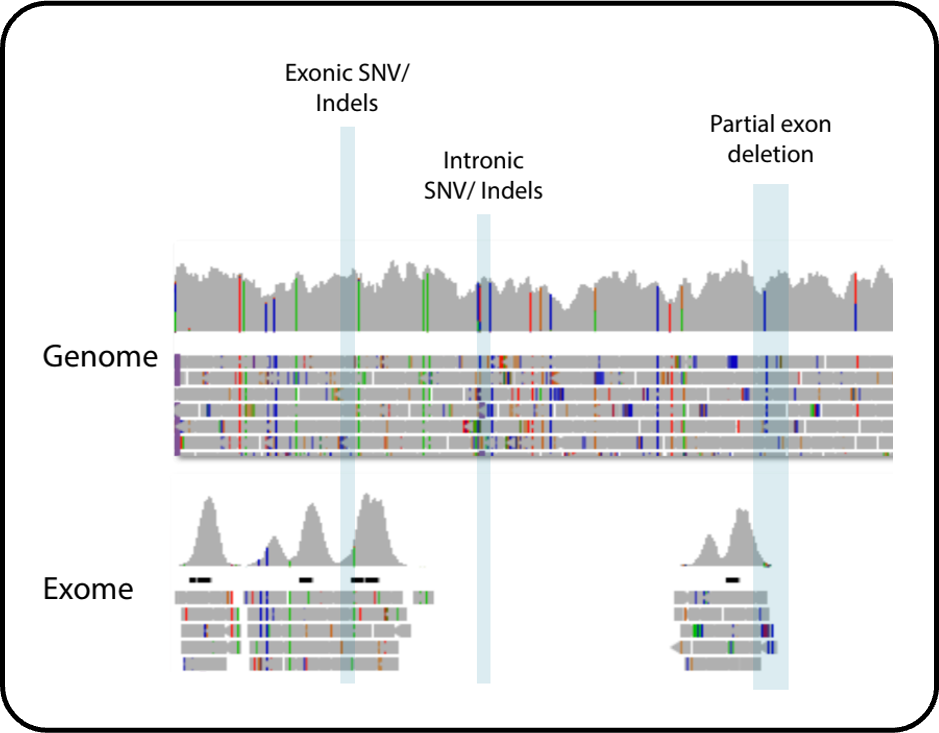
Variants detected by our targeted Genomic Unity® Epilepsy Analysis include:

Sequence variants
Including SNVs, indels, intronic and regulatory variants in 380 epilepsy-associated genes

Structural variants
Including CNVs (duplications, deletions), inversions and MEIs in 380 epilepsy-associated genes

Repeat expansions
Repeat expansions in the AFF2, ARX, CSTB, DIP2B, FMR1 and GLS genes
Our comprehensive analyses extend detection to >30 additional repeat expansion genes, mitochondrial sequence variants (with heteroplasmy) and mitochondrial deletions. View our epilepsy test portfolio.
More variants are revealed with greater resolution
Our whole genome platform has a detection range from 1bp to whole chromosomal events. Intronic and intergenic regions are always included. As a result, our testing identifies copy number variants (plus complex structural variants like inversions) missed by other exome and panel tests. Explore two representative example cases.

Rett syndrome diagnosis
Variantyx testing identified a 453bp partial exon deletion in MECP2 previously missed by an epilepsy panel, whole exome sequencing and whole genome sequencing by another provider. Patients with diagnosed MECP2 variants are now candidates for treatment with Trofinetide.
X-linked DEE2 diagnosis
Variantyx testing identified a 2.1kb single exon deletion in CDKL5 previously missed by chromosomal microarray (CMA), an epilepsy panel and whole exome sequencing. Patients with diagnosed CDKL5 variants are now candidates for treatment with Ganoxolone.
Learn more about our testing options
All epilepsy genetic tests are not equal. With our whole genome platform we see more. More variants, with greater resolution, all with one sample.

A targeted, diagnostic test to identify genetic variants that cause seizures, with or without other symptoms.
- Performed on a whole genome platform
- Focused on 380+ seizure-associated genes
- Includes analysis of 6 repeat expansion genes
- Replaces sequential CMA, panel and exome testing
- Auto reflex to one of our comprehensive analyses
A targeted, diagnostic test to identify genetic variants that cause mitochondrial disorders
- Performed on a whole genome platform
- Combines mitochondrial genome analysis with 330+ nuclear genes linked to mitochondrial disorders.
- Includes identification of SNVs down to 5% heteroplasmy and large deletions
- Replaces sequential testing of mitochondrial and nuclear genes
- Auto reflex to one of our comprehensive analyses
A comprehensive, diagnostic test to identify genetic variants that correlate with a patient’s phenotype including SNVs, CNVs, and repeat expansions.
- Performed on a whole genome platform
- Analyzes patient DNA jointly with parental DNA when family samples are submitted
- Includes analysis of 37 repeat expansion genes
- Replaces WES-based panel and exome testing
- Auto reflex to Genomic Unity® 2.0
Comprehensive diagnostic test identifying genetic variants linked to a patient’s phenotype, including SNVs and CNVs.
- Performed on a whole genome platform
- Analyzes patient DNA jointly with parental DNA when family samples are submitted
- Includes analysis of 37 repeat expansion genes
- Includes mitochondrial genome analysis
- Replaces WES-based panel and exome testing
- Auto reflex to Genomic Unity® 2.0
Comprehensive test identifying genetic variants linked to a patient’s phenotype, including SNVs and CNVs.
- Performed on a whole genome platform
- Analyzes patient DNA jointly with parental DNA when family samples are submitted
- Includes analysis of 37 repeat expansion genes
- Includes mitochondrial genome analysis
- Replaces sequential CMA, panel and exome testing
- Auto reflex to Genomic Unity® 2.0

The ultimate, comprehensive, diagnostic test that combines short and long-read whole genome sequencing to identify genetic variants that correlate with a patient’s phenotype.
- Includes analysis of 45 repeat expansion genes
- Detects methylation patterns associated with Angelman, Prader-Willi and Fragile X syndromes
- Supports variant phasing
- Replaces all other DNA-based testing