Customized Reporting Options
For comprehensive Genomic Unity® tests, you have the flexibility to choose between an extended or more streamlined, phenotype-targeted reporting.

Focused vs Expanded Reports
Focused Report
The Focused Report is designed to reduce clinical “noise” by targeting high-certainty diagnostic variants directly tied to the primary phenotypes. Typically these are pathogenic or likely pathogenic variants, but variants of uncertain significance may be included when they have a strong clinical correlation to the patient’s reported phenotype.
Expanded Report
The Expanded Report is best suited for cases requiring an extended investigation. It may include additional variants of unknown clinical significance that appear to have a clinical correlation to the patient’s reported phenotype, or pathogenic and likely pathogenic variants with partial or nonspecific phenotypic correlation to the patient’s reported phenotype. Examples include:
- Carrier status: Reported with phenotype overlap, including non-specific findings.
- Risk factors: Reporting of clinically relevant risk factors.
- GUS (Genes of Uncertain Significance): Reported when emerging evidence aligns with the patient’s phenotype.
An example case
A 4-year-old female presented with the following symptoms: motor delay, fatigable weakness, axial hypotonia, waddling gait, gait ataxia, foot joint contracture, atopic dermatitis.
Compare the resulting reports:
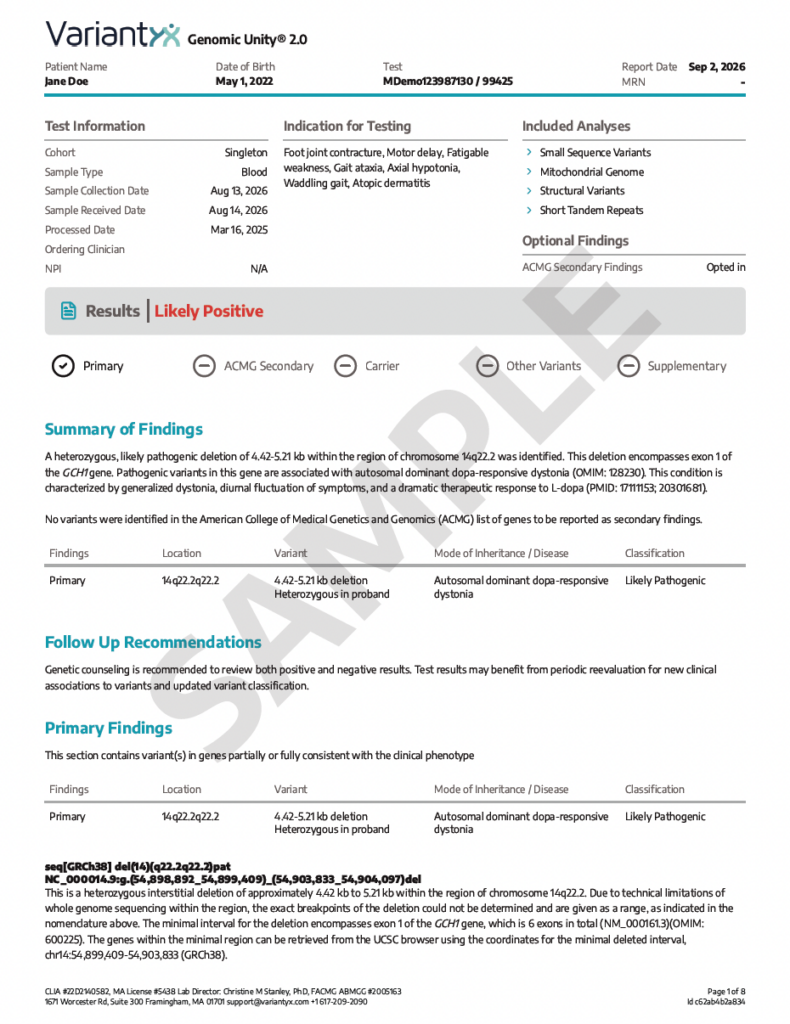
Focused Report
Identifies a heterozygous, likely pathogenic 4.42-5.21 kb deletion spanning exon 1 of the GCH1 gene, providing a diagnosis of autosomal dominant dopa-responsive dystonia.
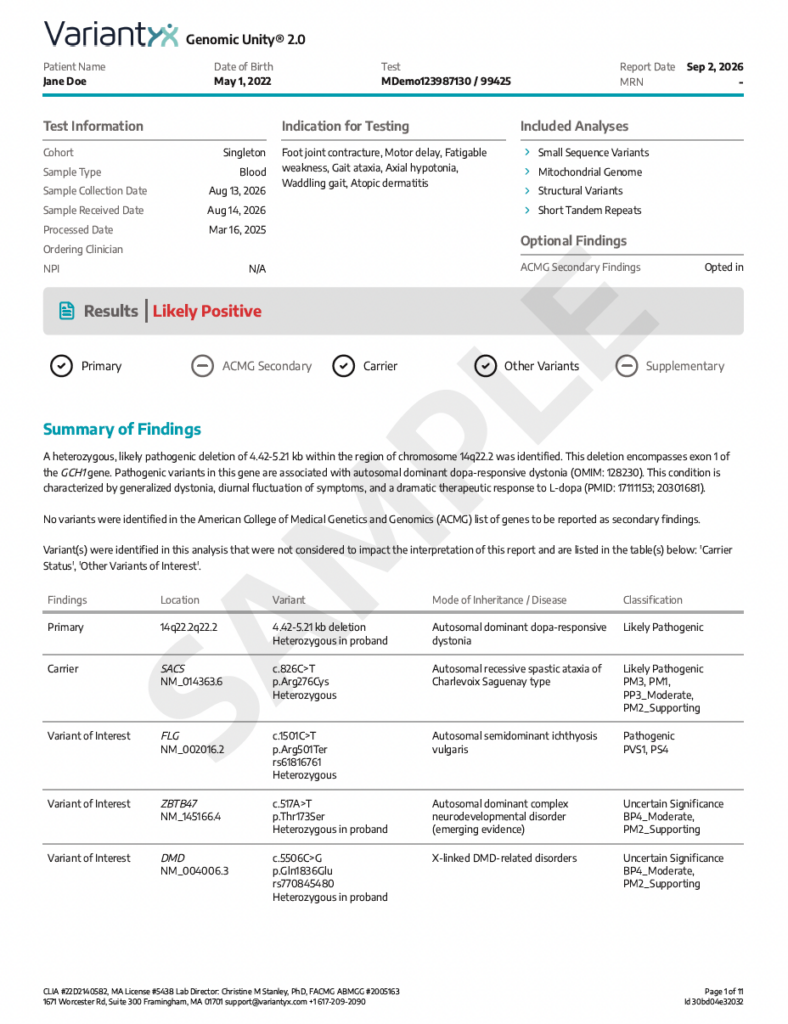
Expanded Report
In addition to the diagnostic GCH1 deletion, identifies a carrier variant in the SACS gene, plus additional variants of interest in the FLG, ZBTB47 and DMD genes.
Tests offering customized reporting options
You will be required to specify your choice of Focused or Expanded Report when ordering the following tests: