

IriSight® Case Study
Overview
Patient:
32 year-old primagravida, 25 weeks gestation
Clinical presentation:
Micrognathia, retrognathia, polyhydramnios
Testing strategy:
Variantyx whole genome testing
Key finding:
Pathogenic intronic variant in the SNRPB gene
Clinical outcome:
Diagnosis established and birth planning plus future reproductive planning enabled
Why IriSight® was the right choice
A routine anatomy scan at 25 weeks identified micrognathia and retrognathia of the lower jaw with associated polyhydramnios and no signs of additional structural anomalies. With no family history of birth defects, differential diagnosis included isolated micrognathia or Pierre-Robin sequence. However, genetic evaluation was necessary to rule out syndromic causes like trisomy 18.
IriSight® was selected as the initial test because it delivers the most comprehensive genomic insights from the start:
- Reducing time to diagnosis
- Avoiding unnecessary testing
- Supporting the highest standard of patient care
Diagnostic finding: Cerebrocostomandibular syndrome
Variantyx IriSight® testing identified a deep intronic, de novo, pathogenic variant in the SNRPB gene. Functional studies have shown that this variant alters protein function.
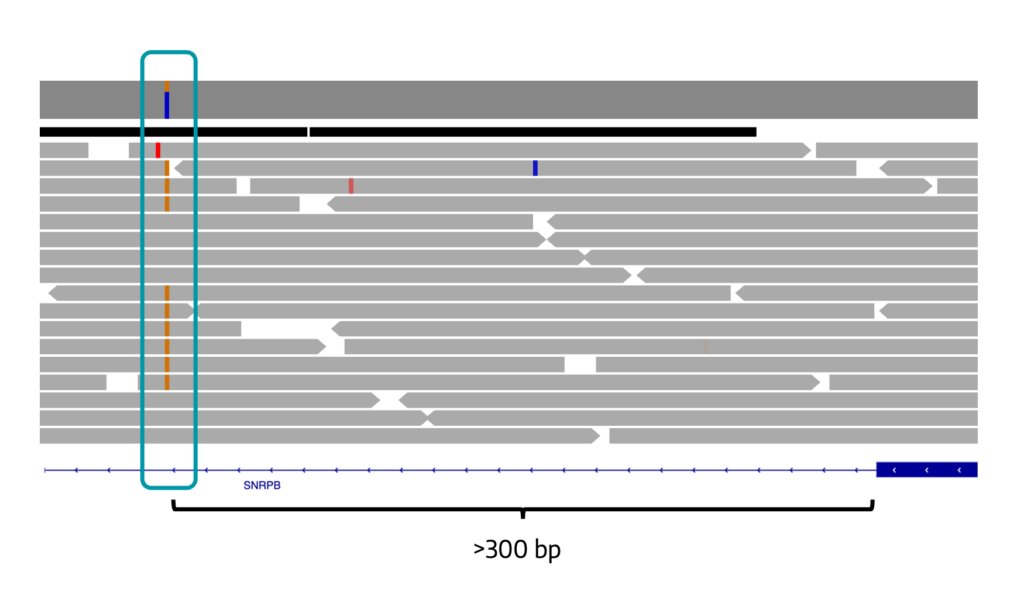
Uniform data from WGS clearly shows the deep intronic variant.
Impact on clinical care
Enabled birth planning focused on immediate, life-saving interventions as well as maximally informative future reproductive planning.
Variant spotlight
Detection challenges
Exome and panel tests focus on coding regions only, ignoring intronic sequences deeper than the +/- 10-20 bp of sequence flanking exon boundaries. This leads to critical coverage gaps and variant blind spots.
Why IriSight®
- Sequences and analyzes both coding and non-coding regions, eliminating coverage gaps and blind spots
- Detects additional variant types that may occur in trans
Additional similar cases

Genomic Unity® – Deep intronic variant explains progressive myopathy
Genomic Unity® – Partial exon deletion plus deep intronic SNV explains juvenile parkinsonism