Genomic Unity® 2.0 Case Study
Overview
Patient:
8-year-old female
Clinical presentation:
Polyphagia, obesity, atypical behavior around food, attention deficit hyperactivity disorder, deeply set eyes, hypertension
Testing strategy:
Variantyx whole genome testing with combined short and long-read sequencing
Key finding:
Heterozygous, likely pathogenic indel in the MAGEL2 gene on the paternal allele
Clinical outcome:
Diagnosis established
Why Genomic Unity® 2.0 was the right choice
While a genetic etiology was suspected, the patient’s non-specific clinical presentation made it difficult to identify a single, likely syndrome that would guide testing.
Genomic Unity® 2.0 was selected because it delivers the most comprehensive genomic insight from the start while:
- Reducing time to diagnosis
- Avoiding unnecessary testing
- Supporting the highest standard of patient care
Diagnostic finding: Schaaf-Yang syndrome
Variantyx Genomic Unity® 2.0 testing identified a heterozygous, likely pathogenic c.528delG variant in the MAGEL2 gene. Using continuous long reads, the variant was determined to be in trans with maternally inherited rs850807 – therefore c.528delG resides on the paternal (Schaff-Yang syndrome associated) allele.
Methylation data is consistent with assignment of the variant to the paternal allele.
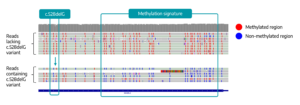
Methylation analysis of long-read sequencing data spanning the MAGEL2 region shows that the variant resides on predominantly non-methylated (blue) reads presumed to be paternal in origin.
Impact on clinical care
Established a definitive diagnosis.
Variant spotlight: Methylation
Detection challenges:
Short-read technologies like exome and standard genome sequencing are unable to detect DNA methylation – a key criteria for definitive diagnosis of imprinting disorders.
Why Genomic Unity® 2.0
- Sequences a patient’s genome twice: once with short-read genome sequencing and once with long-read genome sequencing.
- Long-read sequencing simultaneously detects genetic variants and DNA methylation enabling allele-specific resolution within the MAGEL2 imprinting region.
Additional similar cases

Genomic Unity® 2.0 – Aberrant methylation confirms maternal UPiD of chromosome 15