
Genomic Unity® Case Study
Overview
Patient:
Male in his early 30’s
Clinical presentation:
Pectus excavatum (corrected by surgery), aortic root aneurysm (repaired by surgery), possible scoliosis, keloid scar formation, severe myopia, dental crowding, tall stature
Testing strategy:
Variantyx whole genome testing
Key finding:
Pathogenic intronic variant in the FBN1 gene
Clinical outcome:
Diagnosis established and family testing enabled
Why Genomic Unity® was the right choice
Originally evaluated in adolescence, the patient presented for genetic evaluation of connective tissue disorders prompted by progression of his aortic dilation to an aortic aneurysm and the observed tall stature of his young child. Although Marfan syndrome was suspected, a number of typical features were absent.
Genomic Unity® was selected as the initial test because it delivers the most comprehensive genomic insight from the start while:
- Reducing time to diagnosis
- Avoiding unnecessary testing
- Supporting the highest standard of patient care
Diagnostic finding: Marfan syndrome
Variantyx Genomic Unity® testing identified a deep intronic, paternally inherited, pathogenic variant in the FBN1 gene. The variant is expected to result in loss of protein function.
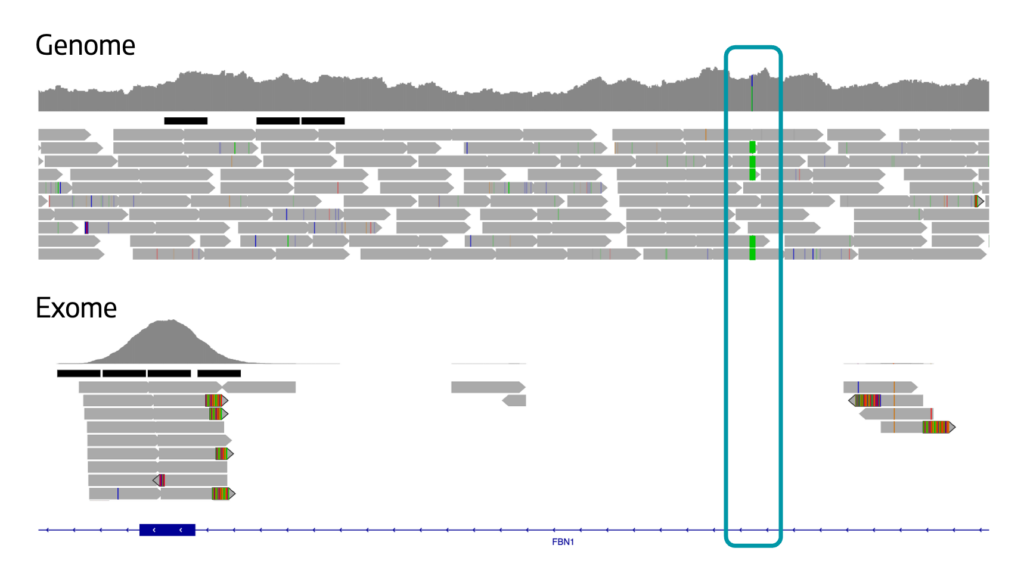
Uniform data from WGS (top) clearly shows the deep intronic variant. The variant is undetectable by exome testing (bottom) due to coverage gaps.
Impact on clinical care
Enabled targeted follow-on screening of at-risk family members, including the patient’s young child.
Variant spotlight
Detection challenges
Exome and panel tests focus on coding regions only, ignoring intronic sequences deeper than the +/- 10-20 bp of sequence flanking exon boundaries. This leads to critical coverage gaps and variant blind spots.
Why Genomic Unity®
- Sequences and analyzes both coding and non-coding regions, eliminating coverage gaps and blind spots
- Detects additional variant types that may occur in trans
Additional similar cases

Genomic Unity® – Deep intronic variant explains progressive myopathy
Genomic Unity® – Partial exon deletion plus deep intronic SNV explains juvenile parkinsonism