
Genomic Unity® 2.0 Case Study
Overview
Patient:
5-month-old female
Clinical presentation:
Small for gestational age, Pierre-Robin sequence, micro/retrognathia, smooth philtrum, glossoptosis, inspiratory stridor, laryngomalacia, secundum atrial septal defect
Testing strategy:
Variantyx whole genome testing with combined short and long-read sequencing
Key finding:
De novo indel on the maternal allele of the UBE3A gene
Clinical outcome:
Diagnosis established, guiding comprehensive evaluation for early intervention
Why Genomic Unity® 2.0 was the right choice
With multiple syndromic and non-syndromic causes competing to explain the patient’s collection of Pierre-Robin sequence features, comprehensive genomic testing was desired.
Genomic Unity® 2.0 was selected because it delivers the most comprehensive genomic insight from the start while:
- Reducing time to diagnosis
- Avoiding unnecessary testing
- Supporting the highest standard of patient care
Diagnostic finding: Angelman syndrome
Variantyx Genomic Unity® 2.0 testing identified a de novo, heterozygous, pathogenic indel in the UBE3A gene.
The variant occurs on the maternal (Angelman syndrome-associated) allele.
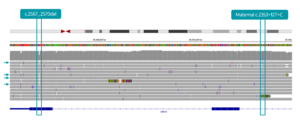
Long-read sequencing provides individual, continuous reads that span the locations of both the de novo variant and a benign, maternally inherited variant – approximately 1,160 nucleotides apart. The continuous reads clearly demonstrate that the variants reside on the same DNA strands and are therefore in cis.
Impact on clinical care
Established a definitive diagnosis, setting in motion a comprehensive evaluation of all potentially affected systems with an eye towards early intervention.
Variant spotlight: Phasing
Detection challenges:
Short-read technologies like exome and standard genome sequencing generate short reads that are assembled into a contiguous stretch of DNA using overlapping sequences. The breaks between individual reads makes it impossible to determine whether variants located thousands of nucleotides apart occur on the same or different alleles – a key factor in determining the parent of origin for de novo variants in imprinted genes.
Why Genomic Unity® 2.0
- Sequences a patient’s genome twice: once with short-read genome sequencing and once with long-read genome sequencing
- Individual, continuous reads thousands of nucleotides in length enable direct phasing of variants at kilobase-scale distances
Additional similar cases

Genomic Unity® 2.0 – Phasing of KDM5B SNV and deletion explains intellectual disability
Genomic Unity® 2.0 – Phasing of GYG1 variants provides a polyglucosan body myopathy diagnosis