
Genomic Unity® 2.0 Case Study
Overview
Patient:
2-year-old female
Clinical presentation:
Neurodevelopmental delay, lower limb hypertonia, plagiocephaly, abnormal facial shape, torticollis, strabismus, downward sloping shoulders
Testing strategy:
Variantyx whole genome testing with combined short and long-read sequencing
Key finding:
Compound heterozygous SNV and 4-exon deletion in the KDM5B gene
Clinical outcome:
Diagnosis established
Why Genomic Unity® 2.0 was the right choice
While the patient’s clinical symptoms were suspected to be genetic in origin, the variety of neurodevelopmental syndromes with non-specific additional phenotypes and anatomical findings made determining a differential diagnosis via targeted testing unlikely.
Genomic Unity® 2.0 was selected because it delivers the most comprehensive genomic insight from the start while:
- Reducing time to diagnosis
- Avoiding unnecessary testing
- Supporting the highest standard of patient care
Diagnostic finding: Intellectual developmental disorder 65
Variantyx Genomic Unity® 2.0 testing identified a heterozygous, pathogenic, maternally inherited p.Tyr1474Ter variant and a heterozygous, de novo, pathogenic 58.62 kb deletion that removes exons 1-4 in the KDM5B gene.
Both variants are expected to result in loss of protein function.
The variants are in trans.
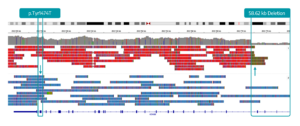
Long-read sequencing clearly shows that the p.Tyr1474Ter variant resides in one haplotype group (colored blue) while the 58.62 kb deletion resides in the other haplotype group (colored red), demonstrating that the variants are in trans.
Impact on clinical care
Established a definitive diagnosis.
Variant spotlight: Phasing
Detection challenges:
Short-read technologies like exome and standard genome sequencing generate short reads that are assembled into a contiguous stretch of DNA using overlapping sequences. The breaks between individual reads makes it impossible to determine whether variants located thousands of nucleotides apart occur on the same or different alleles – a key criteria for definitive diagnosis of autosomal recessive disorders.
Why Genomic Unity® 2.0
- Sequences a patient’s genome twice: once with short-read genome sequencing and once with long-read genome sequencing
- Long reads thousands of nucleotides in length enable assembly of large-scale, extended haplotypes to resolve cis versus trans variant phasing
Additional similar cases

Genomic Unity® 2.0 – Phasing of GYG1 variants provides a polyglucosan body myopathy diagnosis
Genomic Unity® 2.0 – Phasing determines indel parent of origin providing Angelman syndrome diagnosis