Genomic Unity® Case Study
Overview
Patient:
4-year-old male
Clinical presentation:
Hearing impairment, enlarged kidney, nephritis, proteinuria, autism, speech delay, clumsiness, toe walking
Testing strategy:
Variantyx whole genome testing
Key finding:
Pathogenic inversion disrupting the COL4A5 gene
Clinical outcome:
Diagnosis established and family testing enabled
Why Genomic Unity® was the right choice
The patient presented with suspicion for Alport syndrome and a history of affected males who had progressed to end-stage renal disease in the maternal lineage. However, prior targeted testing of a male relative and the patient’s mother had both been negative for Alport syndrome. As had targeted testing of the patient.
Genomic Unity® was selected over exome as a comprehensive test because it delivers the most comprehensive genomic insight from the start while:
- Reducing time to diagnosis
- Avoiding unnecessary testing
- Supporting the highest standard of patient care
Diagnostic finding: Alport syndrome
Variantyx Genomic Unity® testing identified a pathogenic, maternally inherited 4.14 Mb inversion in the Xq22.2 to Xq22.3 region. Spanning multiple genes, the 3′-breakpoint of the inversion falls within an intron of the COL4A5 gene. Disrupting exons 1-18, the inversion is expected to result in loss of COL4A5 protein function.
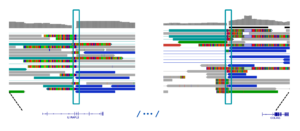
Uniform data from WGS clearly identifies both the intergenic 5′-breakpoint (left) and the intronic 3′-breakpoint (right).
Impact on clinical care
Enabled targeted follow-on screening of at-risk family members.
Variant spotlight
Detection challenges
Exome and panel tests focus on coding regions only, ignoring intergenic and intronic sequences. This leads to critical coverage gaps that make it impossible to detect inversion breakpoints within these regions. Breakpoint detection is the only way to identify disruptive, pathogenic inversions.
Why Genomic Unity®
- Sequences and analyzes both coding and non-coding regions, enabling breakpoint detection regardless of location
- Detects additional variant types that may occur in trans
Additional similar cases

Genomic Unity® – DMD inversion provides genetic diagnosis, enabling access to treatment options
Genomic Unity® – Inversion explains developmental delay and physical anomalies
Variantyx tests that would have identified this variant
Genomic Unity® 2.0 | Genomic Unity® Whole Genome Analysis | Genomic Unity® Lightning Genome Analysis | Genomic Unity® Exome Plus Analysis | Genomic Unity® Exome Analysis | Genomic Unity® Constitutional Genome-Wide Copy Number Variant Analysis | Genomic Unity® Genome-Wide CNV and FMR1 Analysis | Genomic Unity® Nephrology Disorders Analysis | Genomic Unity® Hearing Loss Disorders Analysis